7/10/26 Teen Forest Friday

Doing Hard Things Together: Resilience, Teamwork, and New Skills at Teen Forest Friday
One of our favorite things about our Teen Forest Friday program is watching a group of strangers become a team.

Summer sessions are a little different than our fall and winter semesters. Instead of spending twelve weeks together, our summer groups only have four. That means we have less time to build the friendships and trust that naturally develop over a longer season, so we intentionally create opportunities for students to laugh, connect, and simply enjoy being together.
This week was a perfect example.
Breaking the Ice
We welcomed several new faces before heading up the trail to a shady spot where we stopped for a few classic icebreaker games.
The teens kicked things off with a "snowball fight" (thankfully made of paper instead of snow!) before playing Two Truths and a Lie. It didn't take long for laughter to replace awkwardness as everyone shared funny facts, surprising stories, and a few convincing fibs.
By the time we packed up to continue hiking, conversations were already flowing much more naturally.
Sometimes the best team-building starts with a little silliness.
Staying Cool on a Summer Adventure
Each student received a bandana to keep, and we practiced one of the simplest—but most effective—summer hiking skills.
By soaking the bandanas in the river and wearing them around the neck, head, or wrists, the students learned an easy way to stay cooler on hot hikes. Thankfully, much of our trail followed a small mountain stream, giving us plenty of chances to stop, cool off, and enjoy the refreshing water.
The hike felt especially long in the summer heat, but what stood out wasn't the distance—it was the way the group encouraged one another along the way.
Students offered to help each other, checked in on friends who were getting tired, and kept everyone's spirits high with endless rounds of Would You Rather, storytelling, favorite movie debates, book recommendations, and passionate discussions about sports teams.
Those conversations transformed a challenging hike into a shared adventure.
Nature Is Full of Wonder
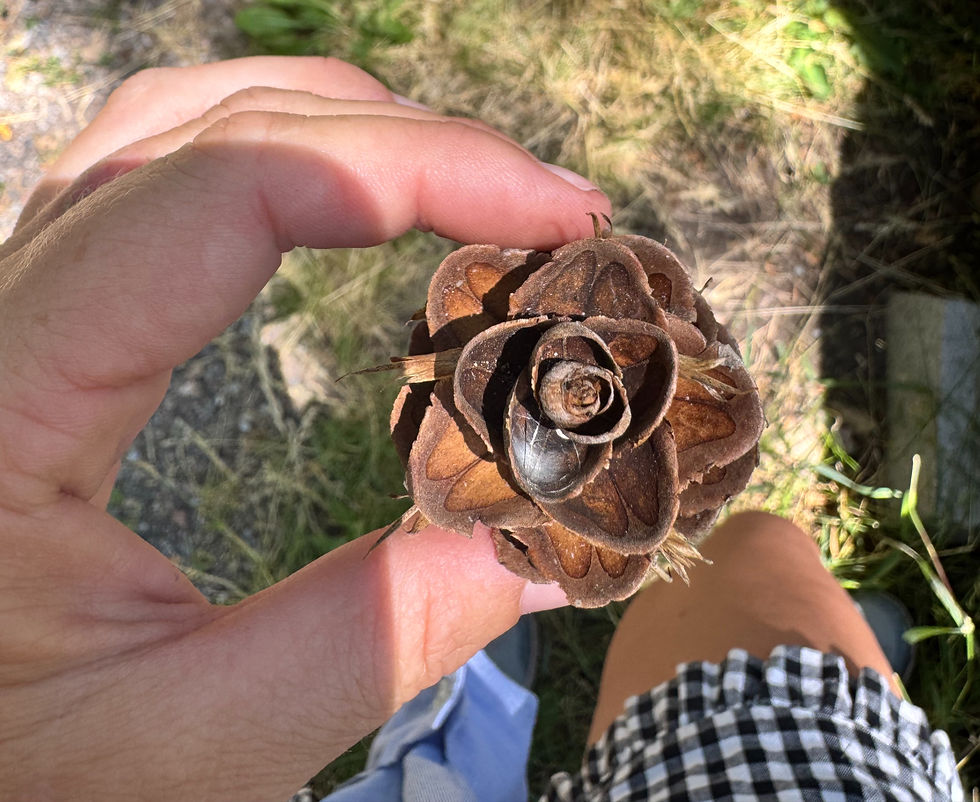
Along the trail, we paused often to notice the incredible details surrounding us.
One of the highlights was discovering goat's beard, a wildflower whose fluffy seed head looks remarkably like an oversized dandelion.
The students tossed the seeds into the air and quickly noticed something fascinating: no matter how they were thrown, each seed spun like a tiny helicopter and always righted itself before floating gently back to the ground.

We also observed the thick white sap that oozes from the stem when it's broken and talked about how plants often have unique adaptations to protect themselves.
Butterflies were everywhere that day, and many students laughed as the same butterfly seemed determined to land on them over and over again before fluttering away.
Nature has a wonderful way of slowing us down enough to notice the small things.

Learning a New Skill
Once we reached camp, we built a shade shelter, settled in for lunch, and then Miss Paige introduced our whittling lesson.
Before anyone picked up a knife, we reviewed the fundamentals of safe carving:
Always carve away from your body.
Stay seated while carving.
Maintain your "blood circle" so no one is within arm's reach.
Then came the harder lesson—not knife skills, but mindset.
We talked about how becoming good at anything requires being willing to be bad at it first.
If you want to become an excellent wood carver, you're probably going to make a lot of rough-looking projects before you create something you're proud of.
Instead of fearing mistakes, we encouraged the students to see each one as practice.
And that's exactly what happened.

When a carving split unexpectedly or a project didn't turn out as planned, nobody quit.
Some students adapted their design into something completely different.
Others simply grabbed another piece of scrap material and started over.
Watching them respond to setbacks with flexibility instead of frustration may have been the most valuable lesson of the day.
Two Challenges, One Team
This week also included two group problem-solving challenges.

The first involved an atlatl dart that had become lodged high in a tree during a previous class. The mission was simple: figure out how to get it back.
The solution, however, wasn't simple at all.
The students brainstormed ideas, experimented with different approaches, and worked
together until they finally succeeded.
Their second challenge was even trickier.

Mr. Kyle asked the group to hang a bear bag high enough in a tree that he couldn't reach it—even by jumping or climbing.
The students tried everything they could think of.
They climbed trees.
They stood on one another's shoulders.
They tied the rope to the atlatl dart and attempted to throw it over high branches.
More than once they thought they had succeeded, only to discover Mr. Kyle could still reach the bag.
So they adjusted.
They tried again.
Little by little, they figured it out.
By the end of the challenge, they not only understood how difficult it can be to properly hang food in bear country—they had also experienced firsthand what perseverance looks like.
Learning to Face Hard Things
Before packing up, Mr. Kyle shared a story comparing buffalo and cows.
When storms approach, cows tend to run away from them, often staying in the storm longer as it catches up to them.
Buffalo, on the other hand, are known for turning toward the storm and walking through it, shortening the time they spend in the difficult weather.
The story sparked a meaningful discussion.
Everything we learned that day could have been taught in a parking lot.
But we chose to hike to a beautiful place instead.
We chose to sweat.
We chose to be uncomfortable.
We chose to work through frustration and keep trying.
Every challenge became another opportunity to prove something important:
We can do hard things.
And every time we choose to face a challenge instead of avoiding it, we build confidence that carries into every other part of life.

We finished the afternoon gathered in a huddle, sharing things we were grateful for before ending with a loud group cheer inspired by one of the day's many inside jokes.
It was the perfect ending to a day filled with laughter, resilience, friendship, and the quiet confidence that comes from discovering you're capable of more than you thought.
🌲 Parent Resources: Continue the Adventure at Home
One of the best ways to reinforce what teens learn at Forest School is to keep the conversation—and the adventure—going at home.
Practice a Growth Mindset
Ask your teen about something they struggled with this week and celebrate the effort they put into learning, not just the outcome.
Try asking:
What mistake taught you the most?
What felt difficult at first but became easier?
What's something you'd like to practice again?
For more on growth mindset:
Mindset
Learn Basic Whittling Safety
If your teen is interested in carving, continue emphasizing safe habits:
Always carve away from the body.
Stay seated while carving.
Keep a safety circle around yourself.
Use a sharp knife with adult supervision.
The Boy Scouts of America offers excellent introductory guidance on knife safety:
Observe Seed Dispersal
Find dandelions, maple "helicopter" seeds, or goat's beard and watch how different plants spread their seeds.
Discuss:
Why do some spin?
Why do others float?
Which might travel the farthest?
Learn more:
Try a Bear Bag Challenge
Using a rope and a small stuff sack in your backyard or at a park (where appropriate), see if your family can hang a "bear bag" high enough to keep it away from imaginary wildlife.
Talk about:
Why campers hang food.
How teamwork helped solve the challenge.
What you'd do differently next time.
Identify Wildflowers Together
Take photos of flowers, butterflies, or insects on your next hike and identify them together using:

Encouraging observation helps teens see the outdoors as a place full of fascinating discoveries rather than just a hiking trail.


